
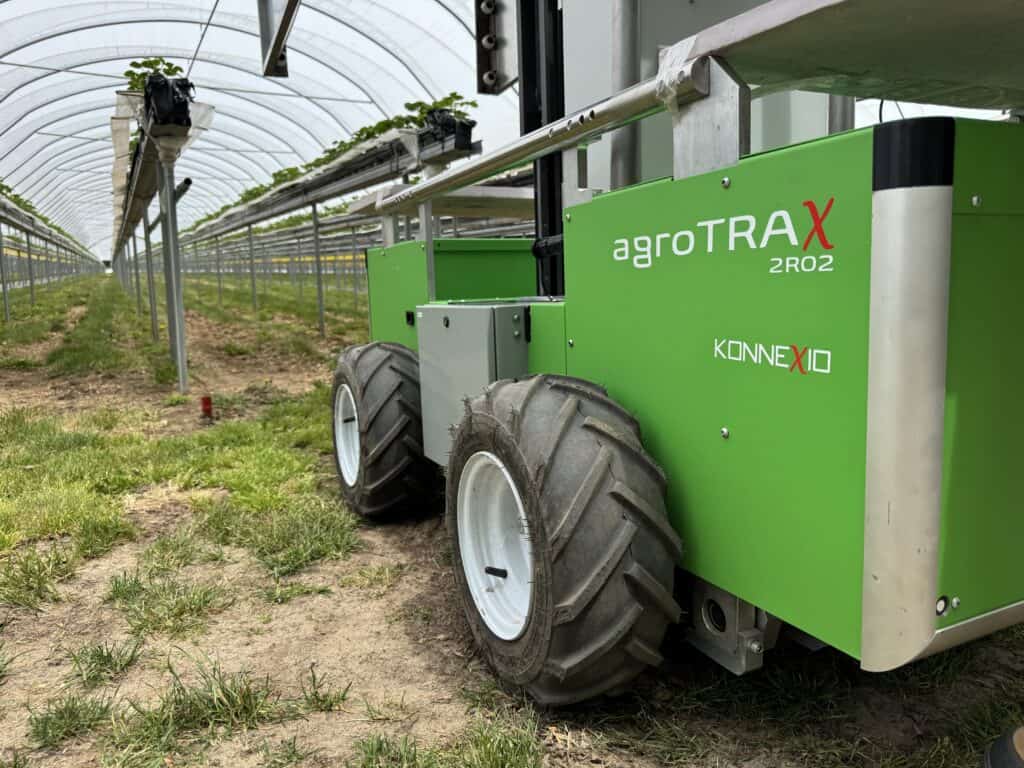
Strawberry production is one of the most labour-intensive horticultural sectors, with growers performing multiple rounds of manual runner removal, truss thinning, and canopy cleaning each season. These tasks are repetitive, ergonomically demanding, and increasingly difficult for staff due to chronic labour shortages. As a result, growers face rising production costs, variability in fruit quality, and limits on operational scalability. Currently, there exists no commercial automated solution that can selectively thin strawberry canopies within intra-row environments or integrate seamlessly with modern tabletop production systems.
This project proposes to develop and validate a vision-guided autonomous thinning module that mounts onto KONNEXIO’s existing autonomous rover platform, agroTRAXTM. The system in the development phase uses RGD-D cameras, embedded artificial intelligence, and multiple servo-driven micro-cutters and lasers inside a protective hood to perform precise removal of runners, excessive trusses, and senescent foliage. By conducting frequent, light-touch thinning across multiple passes—mirroring best agronomic practice—the technology aims to improve fruit-load management, increase marketable yield, and reduce seasonal trimming labour by at least 30% on Canadian commercial farms.
The project will follow a structured research and validation pathway:
1. Data Collection & Model Development: Acquisition and annotation of 4,000–5,000 tabletop strawberry images from Howe Family Farm to train and validate real-time detection models for runners and excess trusses under practical farm conditions.
2. Prototype Engineering & Bench Testing: Fabrication of a 2 full-scale hooded thinning module equipped with stereo cameras, controlled lighting, and 4–6 mechanical micro-cutters and laser. Bench testing will verify cutting accuracy, operational throughput, safety interlocks, and power efficiency.
3. Field Trials on 10 Acres of Commercial Tabletop Production: Full-season validation of agronomic performance, including labour substitution, cutting precision, plant health, marketable yield, fruit size distribution, and maintenance requirements. Independent agronomic oversight will be provided by the Ontario Ministry of Agriculture, Food and Agribusiness (OMAFA).
4. Economic Evaluation and Commercialization Readiness: Quantification of labour savings, yield impacts, and operational costs to produce a validated return-on-investment model. Outcomes will inform final mechanical refinements and commercialization readiness.
This activity directly supports CAAIN’s priorities in automation, robotics, and data-driven decision-making. By delivering a validated autonomous thinning tool ready for pre-commercial deployment, the project strengthens the resilience and competitiveness of Canadian berry producers. Benefits include reduced dependence on seasonal labour, higher crop uniformity, increased marketable yield, and a clear pathway for broader adoption through smart farm networks and industry partners. The resulting technology has potential applications across other high-value horticultural crops, positioning Canada as a leader in precision agricultural robotics.
