
Dr. Michael Ngadi, CEO of Montreal’s MatrixSpec Solutions Inc., and project lead of Optimizing Hyper-Eye: An Integrated Solution for Assessment of Fertility and Gender of Pre-Incubated Eggs is as enthusiastic about his work as he is dedicated to making a difference through the development of his extraordinary technology. “I have been very fortunate that my passion for food and desire to improve its quality and safety have been nurtured in an environment that has seen me surrounded by people I love, admire, and respect,” he says. “That has given me the freedom to engage in fascinating research such as the Hyper-Eye initiative.”
When Dr. Ngadi started this work in 2008, hyperspectral imaging was predominantly used for military applications and essentially unknown in the agri-food sector. The technology, which captures images from both the visible and invisible light spectrums, including different levels of infrared, is still little used for civilian purposes, making this work all the more exciting for him and his team.
“At the time, we had access to a hyperspectral camera and were using it to conduct non-destructive testing of food quality. Out of sheer curiosity, I wondered if there was any way it could be used to assess the fertility of pre-incubated eggs. Now here we are 16 years later, on the verge of commercialising tech that allows us to assess both gender and fertility.”
It’s worth noting that like all good things, this R&D did not come easily. In fact, there was a period when it was completely shelved. Another roadblock saw the team unable to identify an optimal lighting source for photographing the eggs. Finding appropriate light bulbs would seem easy—just go to Canadian Tire and buy what you need, right? In fact, it was a significant challenge because the system involves illuminating the eggs sufficiently to take pictures. The team literally scoured the globe for a solution, experimenting unsuccessfully with a range of off-the-shelf options. Eventually they created their own proving yet again that necessity truly is the mother of invention—though, admittedly, it helps to have really, really smart people working with you.
Dr. Ngadi doesn’t hesitate when asked what the ISED/CAAIN support has meant. “Without your belief in our efforts, and the unprecedented support from the Canadian Egg Industry, we would not have been able to hire the exceptional professionals needed to adapt and advance the technology. It’s important to note that what we have developed with CAAIN’s support will have tremendous impact on one of the poultry industry’s biggest challenges. Because only female chicks are usable, millions of day-old males must be culled annually in Canada alone. Around the world the number climbs to roughly seven billion a year. The process is emotionally demanding of the workers involved, as well as costly, wasteful, and bad for the environment. The successful commercialisation of the Hyper-Eye technology will yield significant increases in profitability, as well as social and environmental improvements. Components of this made-in-Canada solution to a global issue would not have been possible without CAAIN.”
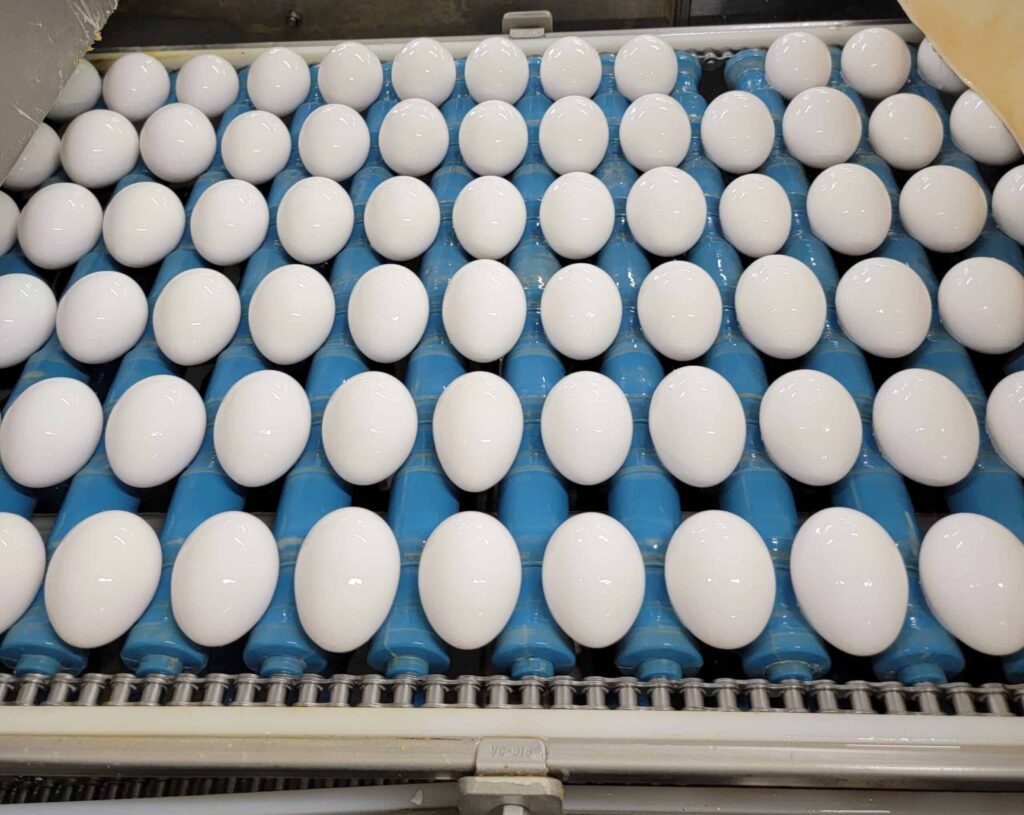
Phase 1 of CAAIN funding focused on the first steps from pilot scale, and saw the team work on the lighting system, develop an algorithm to automate the transfer of images from the camera to the system’s computer, analysing the result for each egg, and predicting the gender. MatrixSpec had to involve a Seattle-based company to help develop the camera-computer interface.
Phase 2 will focus on:
- Using computer vision, machine learning, and deep learning to develop a positioning protocol to identify eggs with incorrect imaging position.
- Using spectral image processing, machine learning, and deep learning to create a quality assessment protocol to identify poor quality (i.e., cracked) eggs.
- Building automated egg sexing quality assurance software based on the positioning and quality assessment protocols, and enhancing the performance by integrating the software into the Hyper-Eye system.
Because this is a testing platform, MarixSpec cannot keep rolling over batches of eggs. Evaluating the platform’s reliability requires that the eggs be incubated and hatched to compare the gender of hatchlings to the predictive results of the Hyper-Eye system. Thus, there’s lag time built into the verification process.
Dr. Ngadi expects to begin evaluating next steps, some time during fourth quarter of 2024, hopefully leading to the launch of commercialisation efforts in 2025.
